Overview
The rock dove (Columba livia), also known as the rock pigeon or common pigeon, is a member of the bird family Columbidae (doves and pigeons). In common usage, it is often simply referred to as the "pigeon", although the rock dove is the wild form of the bird; the pigeons familiar to most people are the domesticated forms of the wild rock dove.
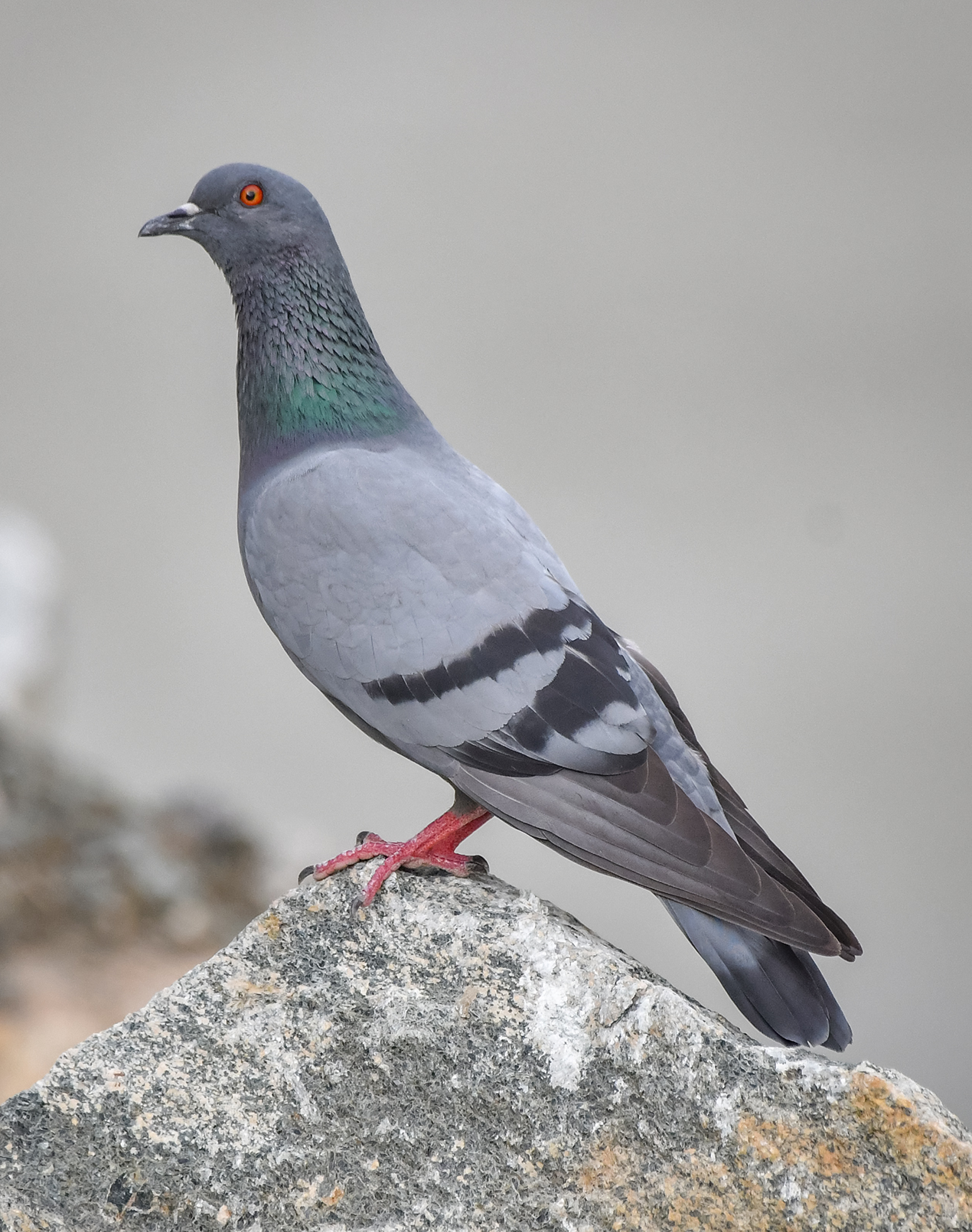
Wild rock doves are uniformly pale grey with two black bars on each wing. The domestic pigeon, which includes about 1,000 different breeds, is descended from this species. Escaped domestic pigeons are the origin of feral pigeons around the world. Both forms can vary widely in the colour and pattern of their plumage.
Description
The adult of the nominate subspecies of the rock dove is 29 to 37 cm long with a 62 to 72 cm wingspan. Weight for wild or feral rock doves ranges from 238–380 grams, though overfed domestic and semidomestic individuals can exceed normal weights.
This species has dark bluish-grey head, neck, and chest feathers with glossy greenish, and reddish-purple iridescence along its neck feathers. The white lower back of the pure rock dove is its best identification characteristic; the two black bars on its pale grey wings are also distinctive. The tail has a black band on the end, and the outer web of the tail feathers are margined with white.
The iris is orange, red, or golden with a paler inner ring. The bill is grey-black with a conspicuous off-white cere. The feet are red to pink. The adult female is almost identical in outward appearance to the male, but the iridescence on her neck is less intense and more restricted.
Distribution and Habitat
Before the Columbian Exchange, rock doves were restricted to a natural resident range in western and southern Europe, North Africa, and extending into South Asia. They were carried into the New World aboard European ships between 1603 and 1607. The species now has a large range, with an estimated global extent of occurrence of 10,000,000 square kilometers.
Wild pigeons reside in rock formations and cliff faces, settling in crevices to nest. They nest communally, often forming large colonies of many hundreds of individuals. Wild nesting sites include caves, canyons, and sea cliffs. Feral pigeons are usually unable to find these accommodations, so they must nest on building ledges, walls or statues.
Urban Adaptation
Feral pigeons have adapted remarkably well to urban environments. Buildings provide an excellent imitation of cliff structures, making rock doves very common around human habitation. Skyscrapers, highway overpasses, farm buildings, abandoned buildings, and other human structures with ample crevices are conducive to rock dove nesting. Thus the modern range of the rock dove is due in large part to humans.
Behaviour and Ecology
Life Cycle
The species can breed at any time of the year due to their ability to produce crop milk, but peak times are spring and summer, when the food supply is abundant enough to support embryonic egg development. Laying of eggs can take place up to six times per year.
The rock dove is generally monogamous, with two squabs (young) per brood. Both parents care for the young for a time. Current evidence suggests that wild, domestic and feral pigeons mate for life. Two white eggs are laid; incubation, shared by both parents, lasts 17 to 19 days. The newly hatched squab(s) has pale yellow down and a flesh-coloured bill. A rock dove's lifespan ranges from 3–5 years in the wild to 15 years in captivity.
Feeding
Rock doves are omnivorous, but prefer plant matter: chiefly fruits and grains. Pigeons feed on the ground in flocks or individually. Pigeon groups typically consist of "producers", which scout out food sources, and "scroungers", which follow the producers and feed on food located by them. Pigeons are naturally granivorous, eating seeds that fit down their gullet. They may sometimes consume small invertebrates such as worms or insect larvae as a protein supplement.
While most birds take small sips and tilt their heads backwards when drinking, pigeons are able to dip their bills into the water and drink continuously, without having to tilt their heads back.
Predators
With only their flying abilities protecting them from predation, rock doves around the world are a favourite prey item for a wide range of raptors. Peregrine falcons and Eurasian sparrowhawks are natural predators of pigeons and quite adept at catching and feeding upon this species. In all life stages, rock doves are at risk from domestic cats, including strays.
Relationship to Humans
Rock doves have been domesticated for several thousand years, giving rise to the domestic pigeon. They may have been domesticated as long as 5,000 years ago. Domesticated pigeons are used as homing pigeons as well as food and pets. They were in the past also used as carrier pigeons, used to deliver messages in peacetime or during war.
The rock dove was central to Charles Darwin's discovery of evolution, and featured in four of his works from 1859 to 1872. Darwin posited that, despite wide-ranging morphological differences, the many hundreds of breeds of domestic pigeon could all be traced back to the wild rock dove; in essence human selection of pigeon breeds was analogous to natural selection.
Rock doves often have a commensal relationship with humans, gaining both ample access to food and nesting spots in inhabited areas. While some view them as pests, particularly in urban environments, they remain an integral part of city ecosystems worldwide.